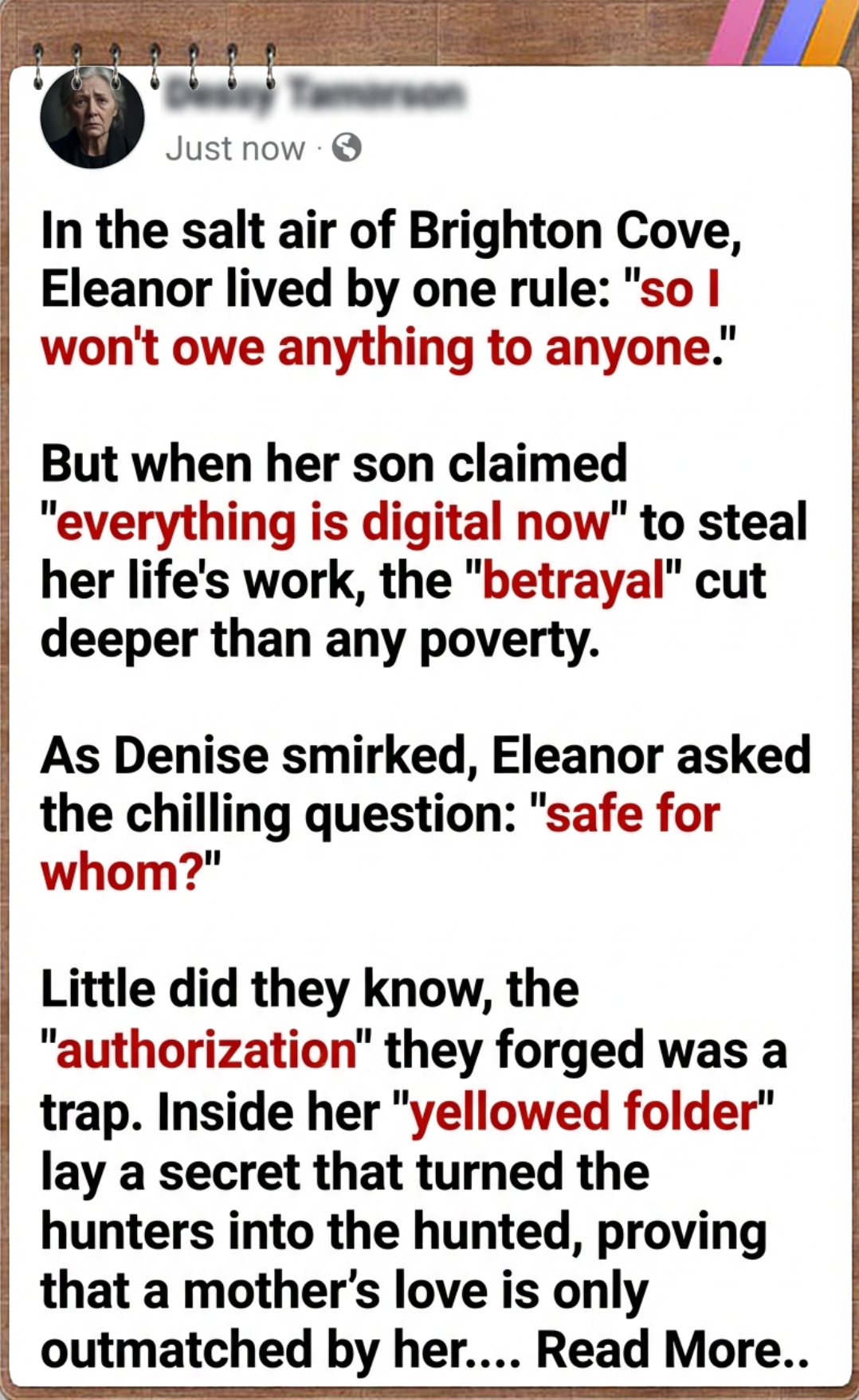
The yellowed folder felt heavy in Eleanor’s hands, its edges frayed like the memories of the life she had shared with Arthur before the sea took him and the silence of widowhood moved in. Mr. Henderson, the bank manager who had overseen the accounts of Brighton Cove for nearly forty years, looked up from his desk, his eyes softening as he recognized the woman standing in his doorway. He remembered her when she was a young mother, her apron dusted with flour, selling hot meat pies to the dockworkers in the biting morning chill. He knew the weight of every dollar she had ever deposited because he had watched her count them, coin by coin, with a dignity that refused to bow to poverty. Eleanor sat down without waiting for an invitation, placing the folder on the mahogany surface between them with a deliberate, slow motion that signaled the end of her period of observation. She had spent the last three weeks watching her son, Matthew, and his wife, Denise, live a life fueled by the theft of her sweat and blood, and she was finally ready to speak. Matthew had always been a boy of soft edges, easily molded by the strongest hand in the room, and Denise had proven to be a hand made of iron wrapped in velvet. Eleanor had watched the way Denise looked at the old Brookswell house, not as a home filled with history, but as an asset to be liquidated. She had seen the way they whispered in the kitchen when they thought she was napping, their voices sharp with a hunger for things they hadn’t earned. When Matthew had convinced her that everything was digital now and that she needed his help to navigate the modern world, Eleanor had allowed herself to be led, not out of senility, but out of a desperate, final hope that her son was still the boy who had promised to protect her. She had signed the papers he placed before her, the ones that created the joint account, and she had done so with the knowledge that she was offering him a choice between loyalty and greed.
The discovery that her account was empty had not been the shock the bank clerk expected it to be; rather, it was a cold confirmation of a reality Eleanor had been sensing in the shift of the air within her own halls. That night, when she had asked Matthew where her money was, and Denise had replied with that tight, artificial smile that it was for her own good, Eleanor had realized that the “protection” her son offered was merely a gilded cage. She had spent the next few days in a state of profound, crystalline clarity. She watched Denise bring home shopping bags from the city, filled with silks and perfumes that smelled of betrayal. She watched Matthew avoid her gaze, his shoulders hunched under the weight of a guilt he wasn’t strong enough to act upon. But what they did not know—what Matthew had forgotten in his haste to digitize his mother’s life—was that Arthur Brookswell had been a man of immense foresight and even greater caution. Arthur had spent his life on the water, and he knew that a ship without a backup rudder was a tragedy waiting to happen. Before he died, he had sat in this very office with Mr. Henderson and drafted a series of documents that were never meant to be seen unless the foundations of the family began to crumble. Mr. Henderson opened the yellowed folder and pulled out the original deed of the Brookswell Trust, a legal entity that had been established fifteen years ago, long before Denise had ever set foot in Brighton Cove.
As the manager scanned the lines, a grim smile touched his lips. He explained to Eleanor that the joint account Matthew had set up was technically a “conduit account” under the overarching terms of the trust. Because the initial funds originated from a protected widow’s legacy, any movement of those funds into a third-party expenditure—like the down payment on the luxury SUV Matthew had just bought or the credit card debts Denise was clearing—triggered a “fraudulent conveyance” clause. But the real sting, the part that would change everything, lay in the “offset and indemnity” provision Arthur had insisted upon. When Matthew and Denise merged their names with Eleanor’s into that joint account, they hadn’t just gained access to her money; they had legally tethered their own financial identities to the trust’s strict fiduciary requirements. By emptying the account for non-essential personal gain, they had committed a breach of trust that authorized the bank to immediately freeze all connected assets to prevent further dissipation of the estate. The “empty” account Eleanor had been told about was merely the beginning of the cascade. Matthew had thought he was draining his mother’s reservoir, but he had actually opened a floodgate that was now draining his own.

That afternoon, while the sun hung low over the harbor, painting the waves in shades of bruised purple and gold, Matthew and Denise were sitting at the dining table, surrounded by brochures for a Mediterranean cruise they intended to book with the “rest” of the money. The silence of the house was shattered by the sound of Matthew’s phone buzzing incessantly. It was his business partner, then his car insurance agent, and finally, a frantic notification from his own bank. Every card was declined. Every business line of credit was halted. Denise grabbed her phone to check their private savings, only to find a message stating that the funds were held in “legal escrow pending audit.” The color drained from her face, leaving her looking older, her beauty stripped away by the sudden onset of a panic she couldn’t control. Matthew sat paralyzed, the brochures slipping from his fingers like dead leaves. He didn’t understand how the digital world he had used to trap his mother had suddenly turned its teeth on him.
Eleanor walked into the room then, her presence filling the space with a weight that seemed to push the air out of the lungs of the two younger people. She didn’t look angry; she looked like the sea after a storm—vast, quiet, and indifferent to the wreckage on the shore. She sat down at the head of the table, the place where Arthur used to sit, and laid the yellowed folder in front of her son. She told him that the money he had stolen was never technically hers to lose, but the trust’s to protect. She explained that because they had used “digital authorization” to move funds in a way that violated the Brookswell Legacy Trust, the bank had exercised its right to seize their personal accounts as collateral to replenish what was taken. Matthew started to speak, to offer some hollow excuse about security and her age, but Eleanor held up a hand, a gesture so sharp and final that he went silent. She told him that she had spent her life working so she wouldn’t owe anything to anyone, and now, ironically, it was her own son who owed the most.
The town of Brighton Cove would talk about that day for years—how the wealthy young couple who seemed to have finally “made it” were suddenly seen packing their things into a U-Haul while the elderly woman they had tried to swindle stood on her porch, her back straight and her eyes fixed on the horizon. Eleanor didn’t take them to court for criminal charges; she didn’t need to. The legal machinery Arthur had set in motion did the work for her. By the time the audit was complete, Matthew and Denise were left with nothing but the clothes on their backs and the realization that they had traded a mother’s love for a bank account they could no longer touch. The luxury SUV was repossessed within the week, and the gray stoneware Denise had bought was left in boxes on the curb. Eleanor returned to her routine—the market, the mass, the coffee with neighbors—but there was a new shadow in her eyes, a mourning for the son she had lost long before the money disappeared.
In the final meeting at the bank, Matthew had asked his mother how she could do this to her only child. Eleanor had looked at him, really looked at him, and seen the stranger Denise had helped him become. She told him that she hadn’t done anything but sign the papers he had asked her to sign. She had simply let the world work the way he insisted it worked now—digital, cold, and governed by the “authorization” he was so proud of. She told him that the money in the trust would now go toward a scholarship for the primary school where she had sold her pies, ensuring that other children would have the education Matthew had used only for deceit. As she walked out of the bank for the last time, the salty air felt fresh and clean. She went back to the house under the yellow light of the old bulb, but this time, she didn’t count coins. She sat in the silence of a house that was finally, truly her own again, knowing that the ghost of Arthur would be proud of the way she had steered the ship through the fog. The people of Brighton Cove still see her occasionally, a solitary figure walking along the cliffs, a woman who proved that while “digital” might be faster, the old ways of patience, observation, and a yellowed folder full of truth were still the most powerful currency in the world. Matthew moved to another town, working a low-level job to pay back the debts the trust had levied against him, while Denise disappeared into the city, her dreams of being a “queen” of the coast shattered by the very greed she had used as a compass. Eleanor remained, a testament to the fact that the quietest voices often hold the most devastating truths, and that a mother’s protection, once betrayed, can become a force of nature that no amount of digital trickery can ever hope to survive.