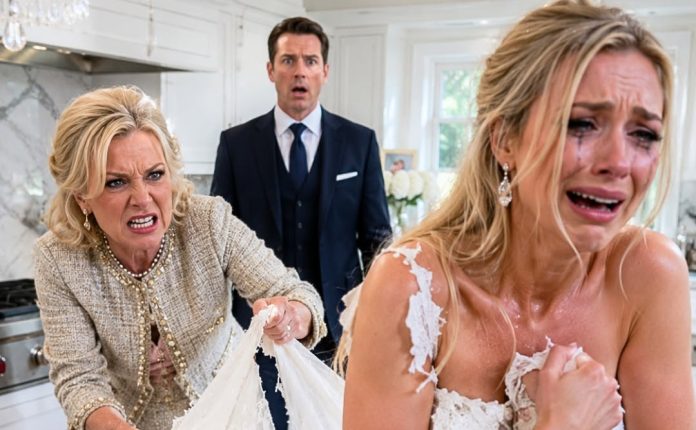
The air in the mansion was always heavy with the scent of expensive jasmine incense and the stifling weight of expectation, a combination that had made it difficult for me to breathe long before the day the world came crashing down. Nanay Ising sat at the head of the mahogany table, her spine as rigid as the traditions she weaponized against anyone who didn’t fit her narrow definition of worth. I remember the way the afternoon light hit the silver tea service, casting long, sharp shadows across the room that felt like omen of the words to come. It’s very simple, she had said, her voice devoid of any grandmotherly warmth or human empathy. Whoever gives birth to a boy stays in this house. Whoever doesn’t… well, she knows where the door is. I remember the silence that followed those words; it wasn’t just a quiet room, but the sound of a five-year marriage evaporating in an instant. I looked at Mark, the man I had built a life with, the man who had promised to protect me, and waited for a spark of outrage or a hand on my shoulder. Instead, he stared at his reflection in the polished wood of the table, his silence a resounding endorsement of my obsolescence. At that moment, the pregnancy I had hoped would be the glue to mend our fracturing relationship became my ultimate wake-up call. I realized then that I wasn’t a wife to them; I was merely a biological vessel, a lottery ticket that they were ready to discard if the numbers didn’t match their desires.
I did not cry in front of them, for I refused to give Nanay Ising the satisfaction of seeing my spirit break. I walked upstairs, my heart hammering against my ribs, and packed a single suitcase with my most essential belongings. I had already suspected Mark’s infidelity for months, but seeing the mistress, Elena, sitting in the corner of the room with a smug, knowing smile had confirmed my worst fears. She was younger, louder, and seemingly more than willing to play the game of producing a male heir to secure her spot in the family’s high-society circle. I signed the annulment papers that I had secretly prepared weeks ago—initially as a “just in case” measure that I prayed I would never need—and left the keys to the house on the vanity. As I walked out into the pouring rain, I felt a strange sense of lightness. I was leaving the “Queen’s” throne vacant for Elena to claim, but I was also leaving a prison that had been slowly suffocating my soul.
I retreated to my family’s small farm in the province, a place where the air smelled of wet earth and calamansi trees rather than expensive perfume and old secrets. My own mother didn’t ask about the sex of the baby or the inheritance I had walked away from. She only asked if I had eaten and if my heart was at peace. While I spent my days working part-time as a remote bookkeeper and my evenings tending to a small vegetable garden, the rumors from the city reached me like distant, ugly thunder. Elena had moved into the mansion and was being treated like royalty. Mark had bought her a luxury SUV, and Nanay Ising had reportedly draped her in the family’s heirloom gold jewelry. The narrative was set: Elena was carrying the “Golden Boy,” the savior of the family name and the heir to the family’s manufacturing empire. They had even held a gender reveal party that was the talk of the town—a vulgar display of blue balloons, blue cakes, and blue fireworks. The arrogance was breathtaking, yet I found myself pitying them. They were building a life on the foundation of a gender, while I was building a life on the foundation of my own strength.
I grew larger and more tired as the months passed, but I was infinitely happier than I had ever been in the mansion. On a quiet Tuesday in my eighth month, surrounded by the scent of fresh rain and the sound of the wind in the trees, I gave birth to a girl. I named her Maya. When the nurse placed her in my arms, I didn’t feel a shred of the “failure” Nanay Ising had predicted. Maya was perfect; she had my eyes and a stubborn chin that suggested she would never let anyone tell her where her place was. She was a person, not a bargaining chip, and I promised her then and there that she would never know the coldness of a family that valued a chromosome over a heartbeat. As Maya turned one month old, the “Royal Birth” occurred in the city. News reached our village via a mutual acquaintance who seemed eager to deliver what she thought would be devastating news. Elena had given birth to a boy, and the family was ecstatic. They were calling him Mark Junior, and Nanay Ising had already set up a multi-million-peso trust fund for him. They said the boy was the image of his father. I simply smiled and thanked the woman for the news. I was finally, officially irrelevant to their drama, and that was the greatest gift I could have received.
The “Golden Age” of the household lasted exactly seven months. In those seven months, Mark and Nanay Ising poured every resource they had into the boy. They expanded the nursery into a massive wing of the house, hired a team of specialized nannies, and fired any staff member who didn’t show the infant enough “reverence.” But as the baby grew, a strange tension began to brew within the mansion walls. The child, while healthy, began to look less and less like Mark as the weeks went by. The “truth that destroyed the family” didn’t come from a dramatic confession or a private investigator’s folder; it came from a routine medical check-up that turned into a nightmare for the “Queen Mother.” It started with a minor respiratory infection that required Mark Junior to be admitted to a high-end private hospital. Because of a history of hemophilia in Nanay Ising’s side of the family, the doctors ran an extensive blood panel to ensure there were no underlying issues. The results were a biological impossibility that sent shockwaves through the family.
Nanay Ising, ever the micro-manager, demanded to see the charts herself, expecting to see proof of her superior lineage. Instead, she found a blood type mismatch that made her heart stop. The real destruction, however, happened when the lead pediatrician, a long-time family friend, pulled Mark aside for a private conversation in the hospital hallway. The doctor explained that he had reviewed Mark’s own medical history from several years prior, specifically a period when Mark had suffered from a severe, complicated case of mumps that had led to orchitis. Based on those records and the current fertility tests the doctor had quietly run to confirm his suspicions, the truth was undeniable: Mark had been sterile for years. The silence in that hospital room was likely much louder than the silence at the dinner table the day I was kicked out. If Mark was sterile, then Mark Junior could not possibly be his son.
The realization hit them like a physical blow, but the jagged shard of glass that truly cut through their vanity was the realization that followed: if Mark was sterile now, when did it happen? In a panic, driven by a toxic mix of hope and desperation, Nanay Ising forced Mark to undergo a modern, comprehensive fertility test. The results confirmed the doctor’s initial findings—total azoospermia. He could not have fathered Elena’s son. Elena, cornered by the sudden withdrawal of the credit cards and the looming threat of Nanay Ising’s legendary wrath, finally broke down and confessed. The “son” belonged to an ex-boyfriend she had been seeing to “ensure” she got pregnant once she realized Mark was having trouble conceiving. She knew the “son equals queen” rule of the house, and she had played the game with ruthless efficiency to win her place. But then, the shadow of my departure loomed over them like a ghost. The doctors concluded that my pregnancy with Maya had occurred during a final, fleeting window of fertility that often occurs briefly before the system shuts down permanently following such illnesses. I hadn’t just left with my dignity; I had left with the only biological heir the family would ever have.

The destruction of their household was absolute and swift. Mark sued Elena for fraud, but the scandal was too juicy for the local social circles to ignore, and the news leaked everywhere. Their social standing, built on the pillars of “tradition” and “legacy,” crumbled into dust. Nanay Ising, the woman who valued bloodlines above all else, realized she had kicked out her only flesh-and-blood granddaughter to roll out the red carpet for a stranger’s child. Elena was evicted within forty-eight hours, her designer bags thrown into the street. The trust fund was dissolved, but the money couldn’t buy back the time or the relationship they had discarded. The mansion, once a place of pride, became a tomb of regrets where Mark spiraled into a deep depression, realizing he had traded a loyal wife and his only child for a lie and a mother’s approval that had always been conditional.
Exactly seven months after Maya’s birth, I was sitting on my porch in the province, watching the sun set over the emerald-green rice fields, when a familiar black luxury car pulled up the dirt driveway. Mark stepped out, looking ten years older and completely broken. Behind him, Nanay Ising remained in the car, her face pressed against the glass, too ashamed to step onto the “provincial dirt” she had once mocked, but her eyes were fixed with hungry desperation on the baby carrier next to me. Mark approached the porch, his voice trembling as he called my name. He told me they had seen the tests and they knew the truth—that Maya was his, and she was the only one. I didn’t stand up to greet him, and I didn’t feel the surge of anger I expected. I only felt a profound sense of distance, as if I were looking at a stranger from a previous life. I told him that Maya wasn’t “his” in the way he thought; she wasn’t a piece of property or a tool to carry on a name. She was her own person, and she was mine. I reminded him that he had made a choice seven months ago to value a gender over a soul, and a mistress over a partner.
Mark pleaded with me, telling me that his mother was willing to change her will and name Maya the sole beneficiary of everything—the houses, the businesses, the entire family fortune. He said Maya would be the queen they always wanted. I looked at my daughter, who was happily playing with a blade of grass, oblivious to the “royalty” being offered to her by the man who had abandoned her. I told him that I didn’t want my daughter to be a queen in a house of cards built on cruelty. I wanted her to be a woman in a house of love, built on respect. I told them to keep their money and their titles, as those things hadn’t brought them happiness and they certainly hadn’t made Mark a man of character. Nanay Ising eventually tried to sue for visitation rights, but she failed miserably; the courts in our province were not inclined to favor a grandmother who had publicly humiliated a pregnant woman and demanded a “son-only” lineage. Today, Maya is a thriving, happy child who loves the outdoors. I never became the “queen” Nanay Ising wanted, but I became something infinitely more powerful: I became a woman who knows her own worth, and a mother who ensured her daughter would never have to win a contest to be loved. Mark and his mother are left with their empty mansion and their cold traditions, while I am left with the sun, the fields, and the beautiful, brilliant girl who saved my life by being exactly who she is.