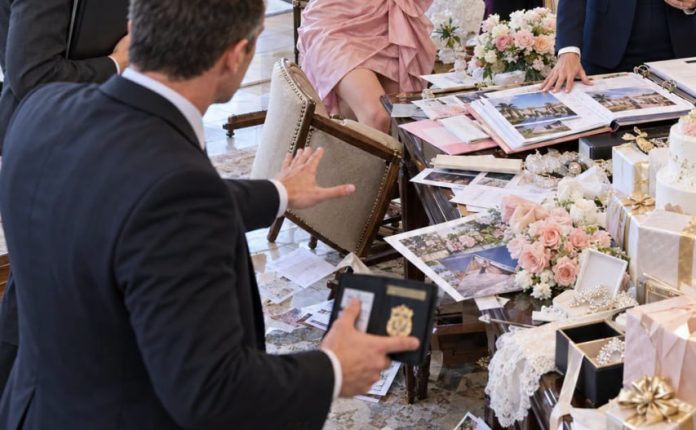
My mother had fresh highlights when I saw her in Courtroom 14. She was smiling at the attorney beside her, unaware that I had stopped in the doorway.
Honey-colored strands curved around her face. She held a takeaway coffee between her palms, warming her hands in a room where I had trouble keeping mine still.
My father sat on her other side. His navy suit fit better than the jackets I remembered from childhood, though he still pulled at his cuffs when waiting for someone else to speak.
Their lawyer noticed me first.
My mother followed his glance and smiled more broadly.
“Claire,” she said. “There you are.”
Twenty-five years disappeared from her voice as easily as a misplaced afternoon.
Mara Whitfield guided me toward our table with a hand near my elbow.
“You don't have to engage,” she said.
I put my bag beneath my chair. Through the leather, I felt the outline of the compass Helen had given me when I was eight.
Across the aisle, my mother leaned forward.
“Whatever happens today, remember that we're your family.”
My father nodded, as though she had offered an uncontested fact.
I looked at the empty witness chair.
The hearing had not begun. My brother had not arrived. On our table, beneath Mara's hand, lay a file thick enough to explain why the people claiming me now had spent most of my life claiming something else.
But the story began before the money, before the courthouse, before I knew how much could be hidden inside a signature.
It began with four shirts.
My mother folded them on my bed in October 1999, smoothing each one with a brisk downward stroke. She packed two pairs of trousers, underwear, socks, and my stuffed rabbit into a blue duffel bag.
I added my library book.
“You won't need that,” she said.
“It isn't finished.”
“Put it on the dresser.”
I obeyed. The bookmark was a strip of yellow paper Daniel had cut from a cereal box. He had written my name along one edge in his crowded, sloping handwriting.
My brother was eleven. I was seven.
For months, our house in Naperville had felt smaller than it looked from the street. My father's office door stayed shut. My parents spoke in the kitchen after we were supposed to be asleep.
Sometimes I heard numbers.
Sometimes my father's voice rose and stopped suddenly, as though he had remembered the staircase carried sound.
His contracting company had once filled the driveway with trucks. By that autumn, only his pickup remained. Men called asking for him, and my mother said he was out even when I could see his shoes beneath the office desk.
That spring, I had suffered recurring fevers.
Doctors examined my throat, pressed fingers beneath my jaw, and ordered blood tests. The illnesses frightened me, but mostly I remembered missing school and being given ginger ale in a cup with a lid.
By September, I was better.
My mother still kept the medical papers in a white folder.
Once, when I entered the kitchen for water, she slid that folder beneath a stack of bills. My father told me to go upstairs.
I thought I had interrupted an argument.
Years later, the memory would acquire a different shape.
Daniel wasn't home when my mother packed my bag. He had spent the weekend with our aunt, and I had been told he would return Monday.
“Will Danny know where I am?” I asked.
My mother tugged the zipper closed.
“Of course.”
That was the first promise she made that morning.
The second came in the car.
The upholstery smelled of orange cleaner. She had polished the dashboard and emptied the ashtray, although neither of my parents smoked. A pale rectangle marked the place where an old parking receipt had lain beneath the windshield.
I held the duffel across my knees.
“Some people are going to help us for a little while,” she said.
“Why can't they help at our house?”
“Because that's not how it works.”
She kept her eyes on the road.
I watched the familiar shops disappear. We drove past a nursery selling pumpkins, then farther west, toward roads I didn't recognize.
“How long is a little while?”
“Until things settle down.”
She said it with the same impatience she used when I asked when dinner would be ready.
At the county intake office outside Aurora, she checked her lipstick in the rearview mirror before getting out.
Inside, the air smelled of floor polish and old coffee. A television mounted near the ceiling showed a daytime program with the sound turned low.
Mrs. Alvarez met us at a desk.
She wore glasses pushed into her hair and had a silver chain attached to them. When she bent to speak to me, the chain swung forward.
“Hello, Claire. That's a good strong bag.”
I tightened my arms around it.
My mother began explaining.
Work difficulties. Temporary arrangements. A child needing more attention than they could provide at present.
Mrs. Alvarez asked where my father was.
“Working.”
“And you've both discussed this?”
“Yes.”
My mother answered too quickly.
There were forms. Several pages. Mrs. Alvarez read portions aloud, stopping to clarify things my mother seemed eager to move past.
I understood none of it.
I knew only that the pen clicked against the desk when my mother set it down, and that she looked relieved when the last page was finished.
She crouched beside my chair.
For one hopeful second, I thought she had changed her mind.
Instead, she kissed the top of my head.
“Be good.”
“Are you coming tomorrow?”
She stood.
Mrs. Alvarez said something about contact arrangements. My mother nodded without answering me.
Then she went through a gray metal door.
I counted the ceiling tiles while I waited.
Sixty-four. Two had brown stains near the fluorescent lights. One corner of a third had been pushed upward, leaving a dark gap.
I counted again.
At some point, Mrs. Alvarez brought me water.
Later, a different woman brought a sandwich cut into triangles.
By evening, I understood that nobody was waiting for my mother to return except me.
The first foster placement lasted six weeks.
The woman there was not cruel. She had three children of her own, worked early shifts, and remembered to wash my school uniform even when she forgot I disliked peas.
But I slept lightly.
Every car slowing outside woke me. Every knock made me sit upright. I kept my clothes folded in the duffel, because unpacking felt like agreeing with something I had not chosen.
When the placement ended, I thought my mother had finally come.
Instead, I moved to another house.
Four months after intake, a caseworker explained that there was no active plan to return me to my parents. They had missed appointments. They had not completed the required steps. Written notices had received no useful response.
She avoided words a child might understand.
I asked the question anyway.
“Did they say I was bad?”
Her pen stopped moving.
“No.”
“Then why?”
She laid the pen flat on her notebook.
“Sometimes adults make choices children can't fix.”
I disliked that answer for years.
It sounded like something people said when they had better answers but didn't want to give them.
Eventually, I understood she had been giving me the one fact I most needed.
The following spring, Helen Ward arrived to meet me.
She was fifty-four, recently retired after thirty-one years teaching middle-school science. She wore brown shoes, a raincoat with a missing button, and an expression suggesting she had already noticed the room's broken wall clock.
“Does that run slow?” she asked Mrs. Alvarez.
“It doesn't run.”
“Then at least it's consistent.”
I laughed before remembering I was supposed to be careful.
Helen glanced at me.
“There you are.”
She didn't mean I had finally appeared.
She meant she had seen something beneath my silence.
Her green Volvo had library books on the back seat and a plaid blanket folded beneath a reusable shopping bag. When she moved the books so I could sit, she apologized to one whose cover had bent.
At her house, she showed me the bathroom first.
Then the kitchen.
Then a bedroom with a yellow quilt, a desk, and an empty shelf.
“You can move things,” she said. “Nothing's sacred except the radiator. It complains if you cover it.”
I stood beside the bed with my duffel.
“How long am I staying?”
Helen did not promise forever.
“As long as we're allowed, and as long as we need to.”
At eight, I heard the uncertainty.
Later, I recognized the honesty.
Newton, her gray cat, disliked my arrival.
He inspected the bag, sneezed at my rabbit, and bit my finger the next morning when I tried to stroke his stomach.
Helen cleaned the small mark.
“He considers that part of the interview.”
“Did I pass?”
“He hasn't packed your belongings. I'd call that progress.”
On my third morning, she made hot chocolate.
Beside the mug, she placed a silver compass.
The case was scratched. Beneath the cloudy glass, the needle trembled when I moved it.
“Estate sale,” she said. “Years ago. I forgot it was in the drawer.”
“Is it mine?”
“If you'd like it.”
I waited for the condition.
There wasn't one.
“What am I supposed to do with it?”
“Know where you're headed.”
She buttered her toast, then looked at me more directly.
“And remember that being somewhere unfamiliar doesn't mean nobody wants you.”
I put the compass in my pocket.
That afternoon, I unpacked one shirt.
Helen noticed and said nothing.
She was good at leaving room for things.
When I cried because another girl at school had asked where my real mother was, Helen didn't deliver a speech about families.
She asked whether I wanted soup or toast.
Then she sat beside me while I ate.
When I broke a glass, I began apologizing before the pieces stopped moving.
Helen fetched a broom.
“Feet first,” she said. “Move your feet.”
Only when I stood safely in the doorway did she look up.
“A glass is replaceable. You don't have to negotiate your place here over one.”
I believed her slowly.
The first time I called her Mom, I was looking for my other shoe.
The word came out before I could stop it.
Helen handed me the shoe.
“Under the sofa.”
She spared me the weight of her reaction.
Four years after I arrived, she adopted me.
There were legal appointments and documents I wasn't required to read. I knew notices had gone out. I knew the adults had tried to locate and contact my parents through the information available.
My parents did not appear to object.
Helen asked whether I wanted to keep Mercer.
“You can,” she said. “Your name belongs to you.”
I chose Ward.
At twelve, I couldn't explain that I wanted the surname attached to the person who knew how I took my tea when I was sick.
After the hearing, Helen bought sandwiches.
We ate them in the Volvo because rain had started, and she didn't want the bread getting wet between the shop and the car.
“Do we celebrate?” I asked.
“We're eating crisps before lunch. That's fairly reckless.”
I leaned against her shoulder.
She put a hand on the back of my head.
That was our celebration.
Life with Helen was full of things too ordinary to describe until they disappeared.
She left the porch light on when I came home late.
She made me telephone if plans changed.
She argued that a bad examination result deserved attention but not a funeral.
She taught me to drive in the Volvo, one hand braced on the dashboard, insisting that turn signals were a form of public courtesy.
At my college graduation, she wore a blue jacket and held the camera upside down for the first three photographs.
When I studied for my broker's examination, she quizzed me from index cards.
“Again,” she said whenever I guessed.
“I know that one.”
“Excellent. Knowing it twice won't damage you.”
I eventually worked in commercial real estate around Chicago.
I liked contracts, measurable obligations, the comfort of discovering that a promise could sometimes be put in writing and enforced.
Helen found that explanation amusing.
“You were always suspicious of vague arrangements.”
She never asked me to repay her for loving me.
When I earned enough to offer her money, she made me inspect a dripping tap instead.
“Start there.”
I knew she had savings.
She had a pension, owned her house outright, and occasionally talked about investments while reading the business pages.
I didn't know how much.
She disliked expensive coffee. She repaired her gardening clothes. The Volvo stayed with her for nearly two decades, until she reluctantly replaced it with a used car whose dashboard she never quite trusted.
There had been family money from an aunt, Arthur later explained, and years of patient investing.
Helen simply didn't confuse having money with announcing it.
In my twenties, she once asked whether I might want contact with anyone from my earlier family.
We were clearing the table.
I stopped stacking plates.
“Have they called?”
“Someone has asked about you.”
I assumed she meant my parents.
“I don't want them here.”
“All right.”
She hesitated.
“If that changes, tell me.”
“It won't.”
She accepted my answer.
I would return to that conversation later with more anger than either of us deserved.
At the time, I was relieved.
At thirty-two, I had a life I liked.
Then Helen suffered a stroke on a Tuesday morning.
I had spoken to her the previous evening. She wanted to know whether pears ripened faster in a paper bag.
“I think so.”
“You think so, or you know?”
“I'll look it up.”
“Don't bother. We'll conduct an experiment.”
The next call came from the hospital.
There was no grand goodbye.
I held her hand. Her nails were short, one cuticle rough from gardening. A nurse adjusted a line and spoke gently without telling me what I wanted to hear.
Helen died at seventy-eight.
At home, her reading glasses lay open beside the newspaper.
On her grocery list, pears were underlined twice.
I kept that list.
A week after the funeral, Arthur Bell asked me to come to his office.
He had known Helen for years. I had met him twice, both times at her kitchen table, where he accepted tea and obeyed her instructions about using a coaster.
Now he offered coffee.
I refused.
He opened a folder and explained that I was Helen's principal beneficiary.
I expected the house, some savings, her books.
I worried about clearing drawers when I still couldn't move her cardigan from the kitchen chair.
Then Arthur named the approximate value of the estate.
“Seven point two million dollars.”
I looked at him.
He waited.
“That's not possible.”
He turned the figures toward me.
It was possible.
The accounts existed. The documents were clear. Helen had reviewed her plans regularly and made arrangements long before her final illness.
My name appeared where she had chosen to put it.
I touched the compass in my bag.
Arthur gave me an envelope.
“She wanted you to have this privately.”
“Is it about the money?”
“Some of it.”
I took it home and left it on the kitchen table.
Grief made simple tasks feel strangely technical. Opening a letter required accepting that its writer would never clarify a sentence or laugh at a misunderstanding.
I wasn't ready.
Six days after the probate filing became public, a local website published a short article about Helen's estate.
It named me as Claire Ward.
I disliked seeing the amount beside her name. It made her sound like a discovery instead of a person.
Eleven days later, a man in a raincoat arrived at my office.
My receptionist thought he was delivering documents for a transaction.
He asked my name.
Then he handed me forty-three pages.
The complaint began with my birth surname.
Thomas and Lorraine Mercer alleged that their missing daughter had been separated from them during a period of financial distress. They described unsuccessful attempts to find me, administrative failures, and Helen's supposed interference.
Their lawyer's argument reached from those allegations toward the estate.
They wanted the inheritance restrained while their claims were heard.
They wanted records, an accounting, and relief their attorney described in language broad enough to cover nearly everything Helen had left me.
Page seventeen portrayed Helen as someone who had exploited a desperate family.
I read that paragraph three times.
My receptionist came to the door.
“Should I cancel your afternoon appointment?”
“No.”
Then I looked at my hands.
“Yes. Please.”
I called Arthur.
He listened without interrupting.
“Send me every page,” he said. “Don't contact them yourself.”
He referred me to Mara Whitfield.
The next morning, Mara read the complaint with a pencil beside her hand.
She didn't appear shocked, which steadied me more than outrage would have.
“When was the adoption finalized?”
“Two thousand four.”
“Do you have the decree?”
“Mom kept everything.”
My voice broke on Mom.
Mara slid a box of tissues closer without watching me reach for one.
I explained the duffel bag, the intake office, the failed visits. I told her my parents had never written, never called, never appeared.
“Now they say they searched.”
“They've made allegations,” she said. “Our task is to answer with evidence.”
“Can they take her money?”
“Family history doesn't give someone an automatic right to another person's estate. But we must deal with what they've filed properly.”
She tapped the complaint.
“And we need to understand why they believe this version can survive scrutiny.”
That afternoon, I drove to Helen's house.
The mug on the draining board was still upside down. Her cardigan hung over the chair. I stood beside it until the refrigerator motor started and startled me.
Upstairs, her filing cabinet was organized with the irritating thoroughness I had once teased her about.
TAXES.
HOUSE.
CLAIRE.
My adoption decree lay in a folder with school reports and vaccination records.
Behind it sat a sealed brown envelope.
If the Mercers contact you, take this to a lawyer.
I read the handwriting twice before sitting on the floor.
There were letters inside, a chronology, copies of agency correspondence, and directions to a locked document box in the drawer beneath her desk.
Arthur held the key.
I called him.
“She expected this.”
“She knew there were unresolved matters.”
“What matters?”
“Let's look at the records together.”
“Why didn't she tell me?”
His pause was careful.
“Please read her letter, Claire.”
I carried the unopened envelope from his office downstairs.
Helen's letter began with ordinary instructions. A shelf in the pantry needed securing. The loose paving stone by the back door would eventually injure somebody.
Then her handwriting changed, becoming smaller.
She wrote that she had tried to protect my childhood without turning it into an investigation. Some facts had been incomplete. Some choices had been hers, and she wasn't certain she had made all of them correctly.
I disliked that honesty for a moment.
I wanted her to be alive so I could be angry with her.
One sentence stopped me.
If Daniel reaches out, let him explain before you decide.
My brother.
I remembered his bicycle on the driveway. His elbow against mine while we watched television. The way he checked my room after our parents argued, pretending he had only come to borrow a pencil.
I hadn't seen him since the week before intake.
My phone vibrated on the table.
The number was unfamiliar.
Claire Mercer? I'm Daniel. I saw the article. Please don't sign anything they give you.
I stood so quickly the chair struck the cupboard.
A second message appeared.
Helen told me where to bring the box if this happened.
There were two boxes, though I didn't know that yet.
One beneath Helen's desk.
One in the keeping of the boy who had been left behind in the house I escaped.
I looked at the screen until the letters stopped appearing to move.
Then I typed a question.
What did they tell you happened to me?
The answer took several minutes.
Long enough for me to imagine every possible explanation except the one he sent.
They told me you died.
END PART 1