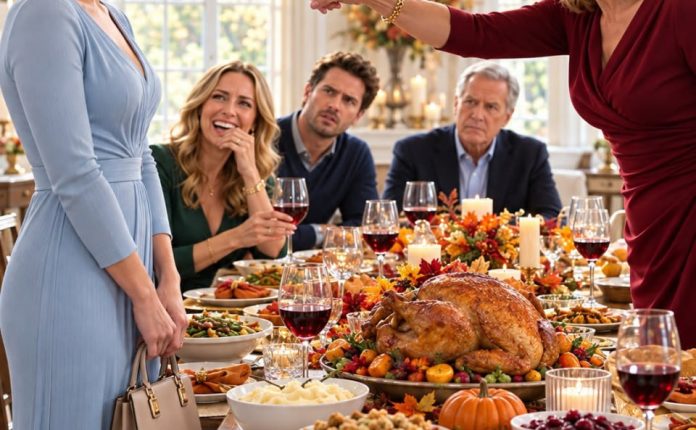
On Christmas morning, Ethan came into the kitchen holding his sweater.
He did not put it on.
He laid it on the empty chair beside him and asked whether we could stay home all day.
“Yes,” I said.
He looked toward the window.
“Even if Grandpa calls?”
“Even then.”
I made pancakes while potatoes roasted in the oven. The combination looked strange on the plate, but Ethan had chosen it, and he ate with the concentration of someone completing an important experiment.
His cheek had darkened overnight.
The bruise was not large. That did not make it easier to see.
I checked him against the clinic’s instructions, then helped him open his presents.
He liked the wooden railway set best.
We built a route beneath the table, around one chair leg, and through a tunnel made from a cereal box.
For nearly an hour, he forgot to look toward my phone.
I let it vibrate on the counter.
Dad called three times.
Olivia called once.
June sent a photograph of the family gathered beside the Christmas tree after we had left.
I stared at the picture before deleting it from the message thread.
Dad stood in the center.
Olivia stood beside him.
The spot where Ethan had fallen was hidden behind a footstool.
June wrote, Wish you could have stayed. We need to put this behind us.
I replied with two sentences.
Ethan was struck and injured. Please do not send us photographs from the party or ask him to move past it.
She read the message.
She did not answer.
That afternoon, while Ethan watched a film beneath a blanket, I spoke to a police officer through the reporting number the clinic had provided.
I described the sequence without adding what I thought Olivia felt or intended.
She stepped backward.
Her heel caught his shoe.
He stumbled.
Juice struck her dress.
She slapped him.
He fell.
My father blamed him and told us to leave.
The officer asked for witness names and whether anyone had recorded the event.
I gave Daniel’s details and explained that I did not yet know about a recording.
He told me how the report would be followed up.
There was no dramatic promise.
No one said that everything would be fixed.
A record was made. There would be questions. I would need to preserve messages and medical information.
That was enough for the next step.
When I finished, Ethan stood in the doorway.
“Was that about me?”
“Yes.”
“Am I in trouble?”
“No.”
He rubbed the bandage on his palm with one finger.
“Is Aunt Olivia?”
“The grownups helping us will talk to her.”
He considered this.
“Will she yell at them?”
“I don’t know.”
“Will they have to go home?”
I put down the phone.
“No one can send those people away for asking what happened.”
He nodded, but I could see the effort it took to imagine adults who could not be dismissed by my father.
That evening, Daniel called.
Before discussing business, he asked how Ethan was feeling.
I told him.
“I’m sorry I didn’t intervene faster,” he said.
“You came outside.”
“Afterward.”
He did not try to turn that into enough.
I appreciated it.
He explained that he had returned to the house to collect his coat and ask whether anyone had checked on Ethan.
“Your father said the situation had been exaggerated.”
I looked at the towel beneath the drawing.
“What did Olivia say?”
“That he collided with her and she put out her hand reflexively.”
I sat down.
“She hit him after he spilled it.”
“I know.”
Daniel paused.
“There is a recording.”
For a few seconds, all I heard was Ethan moving a train across the floor.
“Who made it?”
“Nora Vale. The server.”
I remembered her standing at the doorway with the tray against her hip.
“She was taking a short video of the room for the catering manager. They needed to confirm that the service stations were set up. Her phone was propped beside the dining room entrance.”
“Was Ethan in it?”
“Yes.”
“Did she give it to you?”
“She showed me. I asked her to preserve the original and speak to you directly. I didn’t want it forwarded around the family.”
He gave me her number with her permission.
Then he said, “There’s something else.”
“The documents.”
“Yes.”
I held the edge of the table.
“My sister told you I’d approved.”
“She did. Your father confirmed that the owner consent was complete and that you had cleared the technical questions.”
“I did neither.”
“That is what I now understand.”
His voice had changed. It was still courteous, but the conversation had become formal.
“My firm cannot proceed on uncertain representations. We have put the proposed investment on hold pending verification.”
I closed my eyes.
Olivia would call that my doing.
Dad would too.
But a hold was not a punishment I had requested. It was the ordinary consequence of discovering that the information underlying a decision might be false.
“I’ll work through counsel,” I said.
“That’s appropriate.”
He gave me the contact information for his firm’s lawyer.
Before ending the call, he added, “The financing questions don’t affect what I witnessed. Those are separate matters.”
I had needed someone to say that.
My family would try to combine them into a single accusation: Claire ruined everything because she was upset.
Daniel had seen the sequence.
He was refusing to let the sequence be rewritten.
Nora called me that night.
She sounded younger over the phone than she had looked at the party.
“I’m worried about my job,” she said.
“Have they threatened you?”
“Not exactly. The manager said the family was unhappy about a staff member discussing guests.”
“Did you send the recording anywhere?”
“No. I saved it. Daniel said not to edit it.”
“Thank you.”
“I should have done something when she hit him.”
I looked through the doorway at Ethan, who was placing a toy passenger beside his station.
“I understand what freezing feels like,” I told her.
There was a silence.
“My little brother used to apologize whenever our father got angry,” she said. “Your boy sounded the same.”
I did not ask for details.
She offered to provide the video to the officer and to my lawyer.
I told her I would make sure she had the correct contacts, and that she did not need to confront anyone herself.
Then she asked, “Can I tell you what happened before you came into the room?”
I sat straighter.
“What do you mean?”
“Before you arrived. Olivia was talking to your father near the service table.”
I waited.
“She said, ‘If she signs the clean copy tonight, there’s no problem on Monday.’ He told her to let him handle you.”
The words were not proof of everything.
They were proof that the invitation had carried an expectation I had understood correctly.
They still wanted an actual signature.
Someone had already used a copied one to keep the investment moving.
I thanked Nora.
After the call, I wrote down what she had said and marked it as her account, not my own observation.
I was learning to separate what I knew from what I suspected.
For years, my family had benefited from blurring them.
If I challenged a decision, they called it a feeling.
If they disliked a fact, they called it an interpretation.
I could not afford that fog anymore.
Evelyn arranged a call with an independent lawyer, Mara Singh, for the following morning.
Before it began, I asked my neighbor Lena to sit with Ethan.
Lena had known us since he was a baby. She arrived with a bag of flour, a jar of colored sugar, and no questions he needed to answer.
“We’re making biscuits,” she told him.
“Christmas ones?”
“Whatever shapes you approve.”
He took that responsibility seriously.
I shut the kitchen door and joined the call.
Mara had reviewed the company agreement, the investor packet, my original bank acknowledgment, and the preliminary assessment.
Her first question was simple.
“What outcome do you want?”
I had spent the night imagining what Dad would accuse me of wanting.
Revenge.
Control.
Money.
An excuse to hurt Olivia.
Those possibilities had occupied so much room that I had barely made space for my own answer.
“I want my son safe. I want the false documents corrected. I don’t want my name used again. And I want to know what is happening in a company I partly own.”
Mara nodded.
“Those are distinct objectives. We can take them one at a time.”
She did not promise that owning forty percent meant I could dismiss anyone at will.
It did not.
She explained which decisions required my consent, what information I could demand, and why I should not sign replacement documents simply to make the circulated versions appear harmless.
“A real signature now would create an argument about whether you later adopted the substance,” she said.
“I’m not adopting anything.”
“Then we’ll make that explicit.”
She drafted a notice stating that I had neither executed nor authorized the shareholder consent or technical letter. It required the company to stop representing those documents as valid, preserve records, and identify everyone who had received them.
We sent it to Dad, Olivia, the company’s outside accountant, and the investor’s counsel.
Not to relatives.
Not to social media.
To the people whose decisions depended on the papers being real.
Evelyn added the relevant estate records showing the source of my shares and the shareholder agreement.
Mara requested an owners’ meeting with the outside accountant present.
Monday’s planned investor session would not proceed as an approval meeting. It would become a meeting to clarify the record and determine what independent review was needed.
After the notice went out, my phone rang almost immediately.
Dad.
I let it stop.
Then a message arrived.
You have no idea what you have just done.
I read it once.
I forwarded it to Mara.
Through the kitchen door came the sound of Ethan laughing.
Lena had made a biscuit shaped like a boot.
For a moment, the contrast made me dizzy.
Two days earlier, I would have left the kitchen, returned Dad’s call, and spent an hour trying to convince him that I was not his enemy.
Now I stayed where I was until the legal conversation ended.
When I opened the door, Ethan held up a biscuit with a crooked red nose.
“It’s a new reindeer,” he said.
“May I have one?”
“The broken one is still ours, though.”
“Yes.”
He placed the biscuit on my plate.
“Good.”
Dad arrived at our house that afternoon.
I had told him in writing not to visit without agreement.
He knocked anyway.
Ethan was upstairs with Lena, arranging books into a fort.
I stepped onto the porch and closed the door behind me.
Dad looked past my shoulder.
“Where is he?”
“Inside.”
“I brought him something.”
He held a gift bag with red tissue paper.
“You can leave it here.”
“I want to see my grandson.”
“Not today.”
The cold had reddened the edges of his ears. He looked offended by the weather, the closed door, and my tone.
“This has become ridiculous.”
“Which part?”
“You calling lawyers on your own family.”
“The documents bearing my signature are false.”
“Administrative mistakes happen.”
“Not like this.”
He shifted the bag into his other hand.
“Olivia is under enormous pressure. People are waiting on this financing. Employees have mortgages.”
“I know. That’s why accurate documents matter.”
He stared at me.
“Do you intend to make your sister lose her position over a spilled drink?”
I took a breath.
“She slapped Ethan.”
“She reacted badly.”
“She struck a six-year-old child.”
“Stop saying it that way.”
“There isn’t another accurate way to say it.”
He looked toward the window.
For the first time, I saw him calculate whether Ethan could hear.
I had spent my childhood watching that calculation: not whether the words should be said, but whether the wrong person might hear them.
“You’re upsetting the boy,” he said.
“No. I’m keeping this conversation outside.”
“Let me talk to him.”
“What would you say?”
“That his grandfather loves him.”
“And would you tell him he did nothing wrong?”
Dad hesitated.
It was brief.
It was enough.
“He should still understand that carrying a drink—”
I opened the door behind me only far enough to step through.
“Leave the bag on the porch if you want.”
“Claire.”
“Please go.”
I closed the door.
I did not lean against it.
I went to the window and waited until his car left.
Lena stood at the bottom of the stairs.
“He didn’t hear,” she said.
I nodded.
Only then did I start shaking.
She took my hands between hers.
“Do you need ten minutes?”
“Yes.”
“I’ve got him.”
I went into the bathroom and sat on the closed toilet lid.
There was no satisfaction in it.
No triumphant relief.
I had kept Dad out of the house, and it hurt in a place that still wanted him to become someone else.
I let it hurt without reopening the door.
Later, I checked the gift bag.
Inside was a remote-controlled car.
There was no note.
I put it in the cupboard.
Ethan did not need to decide whether accepting a toy meant accepting what had happened.
That evening, Nora sent the recording through the method the officer had provided and gave a copy to Mara.
I watched it once.
The camera faced diagonally across the dining room. It captured the service table, part of the sitting room, and the path Ethan took toward Dad.
There were several seconds of ordinary party noise.
A guest moved a chair.
Nora adjusted a tray.
Then Ethan entered the frame.
He was walking.
Olivia stepped backward.
Her heel caught his shoe.
The cup tipped.
She looked down at the stain.
Her hand rose.
The recording captured the slap and the silence after it.
It captured me dropping to the floor.
It captured my father saying that Ethan had caused it.
It captured him pointing toward the door.
I stopped the video there.
I could not watch myself leave while knowing that my son had asked whether his grandfather loved him.
Mara asked whether I wanted her to handle future review of the footage.
“Yes.”
She did.
The video resolved the physical sequence, but it did not resolve the other question.
Who had used my signature?
The company’s accountant, Paul Mercer, called Mara on Sunday afternoon.
He had preserved the original packet and the email by which Olivia’s office had sent it.
He also had an earlier draft without signatures.
The company’s shared files showed a revised version uploaded from Olivia’s user account.
That did not establish who had been at the keyboard, Mara cautioned.
But it gave the review somewhere concrete to begin.
Paul said he had assumed the signatures were legitimate because the covering email stated that both shareholders had completed approval.
Dad had been copied.
No objection appeared in the thread.
I sat with that fact for a long time.
Dad’s silence in an email resembled his silence in a room.
Except at the party he had not stayed silent.
He had actively defended Olivia.
I did not know yet how much he had understood about the documents.
I knew he had seen what happened to Ethan.
There was no review that could make that uncertain.
Sunday evening, Olivia called from a number I did not recognize.
I answered because I expected the clinic.
“Don’t hang up,” she said.
I put the phone on speaker and began taking notes.
“Why are you calling?”
“Because apparently I have to book an appointment with a lawyer to speak to my own sister.”
“Yes.”
“You know that isn’t normal.”
“What did you want to say?”
She breathed sharply.
“I’m sorry he was upset.”
I looked at the towel, now empty because I had moved the drawing to a flat box.
“Ethan was injured.”
“It was a reflex.”
“The recording shows you looking at your dress before striking him.”
Silence.
“What recording?”
“The original has been preserved.”
“Who filmed me?”
“Someone recorded the room.”
“That’s an invasion.”
“It shows what happened.”
“You were always waiting for me to make a mistake.”
I thought of Ethan holding up his picture.
“I was waiting for Dad to accept his grandson’s Christmas present.”
Olivia did not answer.
Then she said, “You don’t understand what that evening meant.”
“Explain it.”
“The financing had to stay on schedule. Daniel was supposed to leave confident. Dad wanted the consent finished. Everyone was watching me.”
“And you hit a child.”
“I said I was sorry.”
“No. You said you were sorry he was upset.”
Another silence.
Her next words came more quietly.
“If I lose this deal, people will remember it for years.”
“Ethan may remember Christmas Eve for years.”
“You can’t compare those.”
“I just did.”
She made a small, impatient sound.
“Sign the clean copy Monday. We’ll replace the packet, and none of the business confusion needs to go further.”
I wrote down clean copy.
“Did you copy my signature?”
“I’m trying to solve this.”
“Did you?”
“Dad knew the packet had to go out.”
“That isn’t an answer.”
“It’s the only answer you’re getting.”
She ended the call.
I sent my notes to Mara.
Then I sat beside Ethan while he read a book about trains.
He stumbled over a long word.
I helped him break it into pieces.
There was something steadying about a problem with an answer that did not depend on another person’s willingness to tell the truth.
At bedtime, he asked whether we would see Grandpa soon.
“Not yet.”
“Because you’re mad?”
“Because I need to know that he understands what happened and will keep you safe.”
“Could he learn?”
“I hope so.”
“Like when I learn words?”
“Some things are harder than words.”
He touched his cheek.
“I don’t want Aunt Olivia there.”
“She won’t be.”
That was a promise I could keep.
After he slept, I prepared for Monday.
Mara asked me to bring the original bank acknowledgment, my signed preliminary assessment, and the unsigned consent folder.
I placed them in separate sleeves.
I added a written timeline.
I did not bring the drawing.
It was not an exhibit in the company dispute.
It belonged to Ethan.
I left it in the flat box on the bookshelf.
Before midnight, Dad sent another message.
We will discuss this like adults. No scenes, no recordings, no accusations in front of outsiders.
I read it at the table where my mother’s shareholder agreement lay open.
Outsiders.
That was what my family called anyone who might refuse its preferred account.
I replied once.
Mara will attend. The documents and the events at the party will be addressed accurately.
Then I silenced the phone.
Monday’s meeting took place in the company conference room overlooking the workshop.
I arrived with Mara.
Dad was already seated at the head of the table.
Olivia sat to his right. She wore a dark jacket and had a pen aligned precisely beside her notebook.
Paul stood near the window.
Daniel and his firm’s lawyer sat together.
The room held none of the party’s softness.
No music.
No champagne.
No cousins who could interrupt with a plea for harmony.
Only a table, a speakerphone, a screen, and people whose names would appear in the minutes.
Dad looked at Mara.
“I thought we could settle this internally.”
“We are settling the facts,” she said.
He looked at me.
I placed the unsigned folder on the table.
Olivia watched it.
Paul began by identifying the packet that had gone to the investors.
He described the dates and the preserved email chain.
Mara asked me to confirm my signature status.
“I did not sign or authorize either circulated document.”
She placed the original acknowledgment beside the copied signatures.
The scanner mark was visible in all three.
Olivia looked away.
Daniel’s lawyer asked whether the company disputed my statement.
Dad rubbed his forehead.
“We knew Claire supported the project in principle.”
“That is not the question,” Mara said.
Olivia picked up her pen, then put it down.
“The approval was expected,” she said.
“Expected by whom?”
“Everyone.”
I looked at her.
“I had asked for revised costs and a new independent review.”
“You were delaying.”
“I was reviewing.”
“You always need one more thing.”
Daniel spoke for the first time.
“One more thing was a document accurately describing unresolved concerns. That is material to our decision.”
Olivia’s mouth tightened.
Paul opened the earlier technical report on the screen.
My actual conclusion appeared beside the clearance letter.
The difference was not subtle.
Dad leaned back.
Olivia looked at him.
For the first time that morning, she appeared less certain that he would interrupt on her behalf.
Mara asked who had prepared the signed versions.
Olivia stared at the table.
Then she said, “I put the signature in.”
The room was quiet.
“I thought we were correcting the file on Christmas Eve. I was not trying to create a permanent issue.”
“You circulated completed approvals that did not exist,” Daniel’s lawyer said.
Olivia turned toward Dad.
“You said she would sign.”
Dad’s expression changed.
He looked at me, then at the documents.
“I said I would get it handled.”
Olivia shook her head.
“Tell them what you actually said.”
Dad’s fingers curled against the edge of his chair.
“Not now.”
“Yes, now. You told me not to let her hesitation hold up the packet. You said to send it and that you would make the signatures right afterward.”
I stared at my father.
He did not deny it.
The false signature had not been an isolated shortcut my sister had hidden from him.
The Christmas invitation had been part of their solution.
And the man who had ordered my son into the snow had expected me to return grateful for another chance to make him happy.
END PART 2