PART 3
Ortiz immediately began recording the call through official equipment.
“What is hidden there?” I asked.
“A metal door behind the wood paneling,” Paige whispered. “Dad keeps a safe inside.”
“How do you know?”
“I saw him open it last Christmas. Colin was with him.”
“Did you see what was inside?”
“Cash. Files. Maybe passports.”
“Where are you now?”
“In Mom’s car. The agents told me I could leave after they copied Mason’s video.”
“Is Colin with you?”
“No. They took him to the local station.”
Ortiz wrote a question on a notepad and turned it toward me.
Does Paige know the code?
“Do you know how to open the safe?” I asked.
“No, but the wall panel releases when you press the third stair from the bottom.”
“Tell the agents at the house.”
“I’m scared Dad will know I told them.”
“He will eventually.”
Paige began crying.
“I should have helped you.”
“Yes.”
“I didn’t know what to do.”
“You could have called for help.”
“I thought Colin would calm down.”
“He didn’t.”
“I’m sorry.”
Her apology could not undo the kitchen floor or the moment she remained beside him. Still, she was giving investigators information that might prevent further obstruction.
“Tell Agent Ortiz everything,” I said.
Ortiz took the phone and arranged for Paige to return with counsel if she wanted. Then she contacted the search team.
Within an hour, a federal judge approved an expanded warrant based on the emergency recording, Mason’s video, the financial investigation, and Paige’s disclosure.
Behind the basement stairs, agents found a concealed room containing two safes, twelve banker’s boxes, several encrypted drives, $286,000 in cash, and passports issued under the family’s legitimate names.
One box held property records.
Another contained inspection reports for housing developments that had never been built.
The reports bore Dad’s electronic approval and signatures from engineers who later told investigators they had never visited the sites.
A locked envelope contained beneficiary documents naming Mom as the owner of companies she claimed she had never heard of.
By morning, the home where I grew up had become an active federal search location.
I remained in the hospital until Saturday afternoon. Ortiz arranged for me to stay in a secure hotel because my address appeared in files on Colin’s confiscated phone.
His messages revealed that he had discussed “pressure options” with a private investigator. The investigator had followed me, photographed my office entrance, and collected information about my routine.
“This was planned,” I said.
“The search of your bag was planned,” Ortiz replied. “The physical attack may have been an escalation.”
“Who warned them about the investigation?”
“We’re examining that.”
She could not disclose details, but I knew the leak mattered. Only a small group knew I was cooperating. If someone inside my firm or the government had alerted Dad, more evidence and witnesses could be at risk.
The story appeared on local news before I left the hospital. Reporters knew federal agents searched the home of a recently retired procurement officer after a family disturbance.
Dad’s attorney issued a statement calling the search excessive and unrelated to the misunderstanding in the kitchen.
Colin’s lawyer described the confrontation as a disagreement over proprietary business documents. He denied that Colin intentionally hurt me.
Mason’s video had not been released, and prosecutors asked me not to speak publicly.
Online strangers filled the silence with speculation. Some claimed I stole corporate secrets. Others said I targeted my family to advance my career.
Mom called the hotel repeatedly.
I ignored the first eleven calls.
On the twelfth, she left a voicemail.
“Nora, we need your help. The government froze our accounts. I can’t buy groceries, your father’s pension is suspended, and Paige has nowhere to go. Whatever happened in the kitchen, we are still your family.”
Whatever happened.
She still could not say Colin attacked me.
I saved the voicemail and sent it to Ortiz.
My firm placed me on paid protective leave. The managing partner assured me that I had followed every rule, but his stiff tone suggested the company feared public attention.
Two days later, internal security identified the leak.
My supervisor, Martin Keene, had accessed restricted case files and sent encrypted messages to Dad. Martin and Dad had worked together on contracts years earlier.
Martin knew I requested recusal after discovering Colin’s company. Instead of protecting the investigation, he warned Dad that I might cooperate.
He was dismissed and later charged with obstruction and unauthorized disclosure of confidential information.
The discovery answered one question but created another.
Martin’s messages showed that Dad knew about the inquiry for five months. During that time, he invited me home repeatedly, asked indirect questions about my cases, and encouraged me to attend his retirement dinner with my work computer because “the house internet was secure.”
He had helped arrange the opportunity Colin used to search my belongings.
The family dinner had been a trap hidden inside a celebration.
I read the messages in a conference room with Ortiz and Assistant United States Attorney Gabriel Ross.
One from Dad said:
Nora still trusts her mother. If Elaine asks, she will stay overnight.
Another said:
Colin can handle the device after she sleeps. No confrontation unless necessary.
My hands went cold.
“Mom asked me to stay,” I whispered. “She said it would hurt Dad if I drove home immediately.”
Ross closed the file.
“We do not yet know whether your mother understood why.”
“She knew something.”
“That will be investigated.”
Dad was arrested the following morning on charges related to conspiracy, fraud, obstruction, and attempted destruction of evidence. Colin faced overlapping charges as well as witness tampering.
Both men pleaded not guilty.
Mom was not initially charged. She told investigators she believed Colin wanted the laptop because I had taken private family information. She denied knowing anything about fraudulent contracts.
The records complicated her claim.
Several shell companies used Mom’s signature. Hundreds of thousands of dollars passed through accounts in her name. Mortgage payments, vacations, jewelry purchases, and Paige’s wedding expenses had been paid from those accounts.
Mom insisted Dad handled every financial detail and often asked her to sign documents without reading them.
That explanation sounded painfully familiar. She had spent years treating ignorance as innocence when knowledge would have required action.
Paige hired her own attorney and began cooperating.
She admitted Colin’s business had paid their mortgage for three years even though she did not understand where the money originated. She also revealed that Colin asked her to open an account in Mason’s name.
“Did she do it?” I asked Ross.
“Yes.”
My stomach tightened. “Mason is fourteen.”
“The account received approximately $430,000 over two years.”
“Did Paige spend it?”
“Some funds paid household expenses. Most were later transferred.”
Paige claimed Colin told her the account was part of an educational trust. Records showed she signed forms identifying herself as the manager of a consulting company.
Whether she knowingly participated would become one of the hardest questions in the case.
Mason moved temporarily to his maternal grandmother’s home. His biological mother had died when he was nine, and I worried he would blame himself for recording the kitchen confrontation.
I asked Ortiz whether I could speak to him.
With his grandmother’s permission, we had a supervised video call.
He appeared smaller than I remembered.
“Are you mad at me?” he asked.
“Why would I be?”
“I recorded Dad.”
“You protected me.”
“He says I betrayed him.”
“Your father made choices. Recording the truth did not create those choices.”
Mason looked down. “Grandma Elaine said families shouldn’t collect evidence against each other.”
“My mother said that?”
He nodded.
“What do you think?”
“I think if I hadn’t recorded it, everyone would say you fell.”
His clarity brought tears to my eyes.
“You did the right thing,” I said. “But none of this is your responsibility.”
“Will Dad go to prison?”
“I don’t know.”
“Will I have to testify?”
“Maybe. If that happens, people will help you.”
He wiped his face.
“I heard Grandpa say your phone was transmitting. After the agents came, Grandma told me I should delete my video before anyone saw it.”
I went still.
“When did she say that?”
“In the dining room, while the agents were helping you.”
“Did anyone else hear?”
“Paige did.”
After the call, I contacted Ortiz.
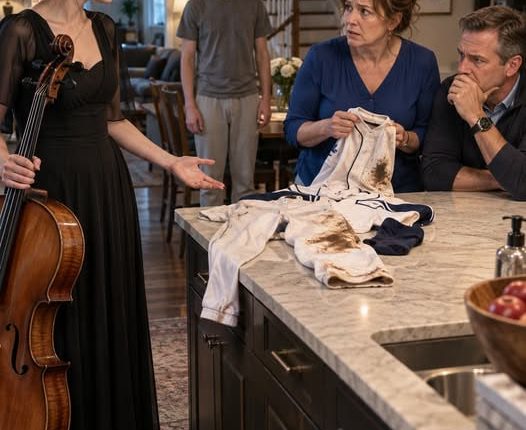
Mom’s request that Mason delete evidence transformed her role. It was no longer only about freezing during a frightening moment. She had tried to remove proof while I was being carried to an ambulance.
Paige confirmed the conversation.
She also disclosed that Mom took Mason’s phone briefly, but he retrieved it before she found the video.
Prosecutors added the incident to the obstruction inquiry.
Mom left me another voicemail that night.
“Paige is saying terrible things because she wants immunity. You know I would never hurt you. I was trying to protect a frightened child from becoming involved.”
I listened twice.
She did not deny asking him to delete the recording.
She simply renamed obstruction as protection.
The government’s financial evidence continued expanding. Investigators calculated that the contracting scheme diverted more than $18 million from emergency housing programs.
Some money funded unfinished projects, but millions moved into private accounts, real estate, political contributions, and businesses controlled by Colin and Dad.
The missing housing was not an abstract accounting problem. Families displaced by floods and fires had waited months for units the government had already paid to build.
I reviewed photographs of empty foundations, abandoned lots, and trailers with unsafe wiring. My family’s comfort had been purchased with public money meant for people who had already lost homes.
The knowledge changed my grief into resolve.
Dad’s attorney requested a private family meeting, claiming Dad wanted to cooperate if prosecutors protected Mom and Paige.
Ross advised me not to attend, but Dad’s attorney said he possessed information about additional conspirators and would disclose it only if I heard his explanation.
We agreed to a recorded meeting at the federal courthouse.
Dad entered in detention clothing, accompanied by two marshals and his attorney. He looked older than he had at the retirement dinner.
“Nora,” he said softly.
I did not respond.
His attorney began by describing Dad as a public servant who made compromises during an emergency. Ross interrupted and requested facts rather than speeches.
Dad looked at me.
“Colin designed the shell companies.”
“You approved the contracts,” I said.
“I believed he would complete the work.”
“After receiving payment?”
“He promised.”
“How much did you take?”
“Less than the records suggest.”
“That is not an answer.”
His attorney advised him not to respond.
Dad leaned forward anyway.
“I wanted to leave something for the family. I spent my career watching contractors become wealthy while I earned a government salary.”
“So you stole.”
“I redirected fees.”
“From emergency housing.”
“From bloated federal budgets.”
I thought of the empty foundations.
“Why did you involve Mom?”
“To protect assets.”
“Paige?”
“Colin handled her accounts.”
“Mason?”
Dad looked away.
“And me?” I asked. “What did you plan to do after taking my laptop?”
“Remove confidential information.”
“Then blame me for losing it?”
He said nothing.
Ross placed one of Martin’s messages on the table. It described a plan to report me for bringing protected records into a private residence. Dad intended to claim I stole the files for personal leverage.
“You were going to end my career,” I said.
“I was trying to stop an investigation that would destroy everyone.”
“You were willing to destroy me first.”
“I knew you would recover.”
The words struck harder than anger would have.
Dad had always called me strong. Like Mom, he treated my resilience as permission to cause damage.
“What information are you offering?” Ross asked.
Dad named two senior contractors and a former agency official. Prosecutors already knew about one. The other names required verification.
Then he made his request.
“If Nora signs a statement saying Colin believed the laptop contained stolen business documents, the witness-tampering charge becomes a misunderstanding.”
I stared at him.
“This meeting was another attempt to use me.”
“Nora, Colin is Paige’s husband. Mason needs his father.”
“Mason needed his father not to attack someone.”
“Think of your sister.”
“I have spent my whole life being told to think of everyone except myself.”
Dad’s composure cracked.
“If Colin receives a long sentence, Paige will have nothing.”
“She can build a life without stolen money.”
“You don’t understand loyalty.”
“No. I finally understand it perfectly.”
I stood.
Dad called after me.
“If you testify, the government will take your mother’s house.”
I turned back.
“The house was bought with money meant for displaced families. It was never truly ours.”
Outside the conference room, Ross told me federal prosecutors intended to seek forfeiture of the house and other properties.
“What happens to Mom?” I asked.
“She can contest the forfeiture as an innocent owner.”
“Can she win?”
“That depends on what she knew and when she knew it.”
The answer came a week later when agents recovered deleted messages from Mom’s tablet.
One message to Dad read:
Nora cannot learn the house came from housing money. She would choose strangers over us.
Another, sent after the kitchen attack, said:
Mason recorded too much. Paige must make him delete it before agents copy the phone.
Mom had known enough.
And she had chosen the money.