PART 2
No alarm sounded. No confirmation appeared. The weather application simply displayed a cloudy sky and a temperature of forty-three degrees.
Colin pulled the phone from my hand.
“Who did you call?”
“No one.”
He examined the screen, saw the forecast, and tossed the phone onto the table.
Dad crouched beside me. For one hopeful moment, I thought he meant to help. Instead, he lowered his voice so only I could hear.
“You need to think carefully about what you do next.”
“I need medical help.”
“You fell.”
“Colin shoved me.”
“He panicked.”
“That does not change what happened.”
Dad looked toward the others. “Everyone saw an argument. Nobody saw an attack.”
A coldness deeper than the open-door air settled over me.
“You’re asking them to lie.”
“I’m asking you not to destroy five lives over one emotional moment.”
“Five lives?”
“Your mother, Paige, Mason, Colin, and mine.”
I looked at him. “You didn’t include me.”
He stood without answering.
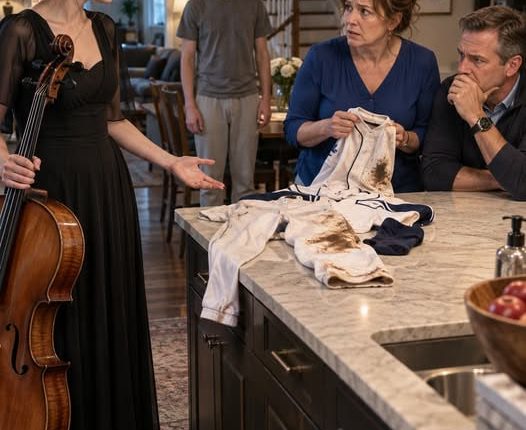
Paige hovered beside the staircase, both hands covering her mouth. Her fourteen-year-old stepson, Mason, had appeared on the landing above us. He wore sweatpants and clutched the railing.
“What happened?” he asked.
“Go back upstairs,” Colin ordered.
Mason looked at me on the floor. “Is Aunt Nora hurt?”
“She slipped,” Mom said.
The lie came instantly.
Mason did not move.
“I saw Dad push her.”
Every adult in the kitchen froze.
Colin looked up at his son. “You were upstairs.”
“I was on the steps.”
“You misunderstood.”
“You grabbed her.”
Paige rushed toward Mason. “Honey, go to your room.”
“But Aunt Nora—”
“Now.”
Mason retreated, but I saw him take his phone from his pocket before disappearing down the hallway.
Colin turned back to me.
“The password.”
“No.”
He picked up my laptop and raised it over the tile.
“Give it to me, or this breaks.”
“There is no evidence stored locally. Destroying it will only add another charge.”
His arms lowered slightly.
I should not have said that, but pain and anger had stripped away my caution.
“What charge?” Paige asked.
“Nora is bluffing,” Dad replied.
I forced myself to my knees, gripping the chair for support. My left leg trembled when I tried to stand.
Mom watched without offering a hand.
“You’ve always been dramatic,” she said. “Even as a child.”
I remembered being eleven and telling her a teacher repeatedly mocked my stutter. Mom said I was too sensitive. When Paige complained about another student once, our parents met the principal the following morning.
Different rules had governed our lives for as long as I could remember.
Dad took my phone from the table.
“Unlock this.”
“No.”
“We need to know whether you recorded anything.”
“You do realize demanding access makes you look guilty.”
He placed the phone in his pocket.
“Until you calm down, I’m keeping it.”
“That belongs to me.”
“So does the laptop,” Colin said.
“My work computer belongs to my employer.”
Dad looked at him. “Can you access it without the password?”
“I know someone who can.”
The statement was captured by the emergency audio channel, assuming the alert worked as agents promised.
I needed to keep them talking.
“What exactly are you trying to erase?” I asked.
Colin paced toward the sink. “Nothing.”
“Then why risk attacking a federal witness?”
Mom gasped.
Dad’s face emptied.
Paige whispered, “A what?”
The investigation team had never formally used that label in front of me, but federal law protected people providing information to investigators. I wanted Colin to believe the consequences were already unavoidable.
He stared at me.
“You went to the FBI?”
I did not answer.
Dad removed my phone from his pocket and studied it.
“When?”
“Why does it matter?”
“How long have they been investigating?”
“Long enough.”
Mom sat at the breakfast table.
“Oh, Nora, what have you done?”
The question nearly made me laugh. I had found evidence and followed the law, yet she looked at me as if I had committed the betrayal.
“I did my job.”
“You reported your father.”
“I reported suspicious payments without knowing who controlled every account. Investigators identified the owners.”
Dad’s voice became strangely gentle.
“You could have come to me.”
“Would you have told the truth?”
“I could have explained.”
“Explain now.”
He looked toward the broken door.
The house had been purchased twelve years earlier after Dad claimed a successful investment had doubled his retirement savings. The property was titled in Mom’s name through a family trust. I had never questioned how they afforded it because Dad spent his career evaluating contracts and always presented himself as financially cautious.
Now I wondered whether the house itself was evidence.
Dad pulled out a chair and sat opposite me.
“Emergency housing programs were chaotic,” he said. “Contractors needed fast approvals. Some expenses were shifted between projects, but every decision kept people employed and construction moving.”
“Were the housing units completed?”
“Most were.”
“The inspection reports list entire developments that don’t exist.”
“You’re reading preliminary files.”
“They were submitted for payment.”
“Because funds would have expired.”
I stared at him. “You approved fictional construction so agencies would release money before the deadline.”
“We intended to complete the work later.”
“Did you?”
Colin answered. “Material prices increased.”
“Then where did the money go?”
“No one stole anything,” Dad said.
“Show investigators the accounts and prove it.”
“That process would ruin us before anyone listened.”
Mom reached toward me. “Your father made difficult choices during a crisis.”
I moved away from her hand.
“How much money came into this family?”
“Nora,” Dad warned.
“Millions are missing.”
“We didn’t take millions,” he said.
The word “millions” had been deliberate. I had never told them the estimated amount.
“You know how much is missing.”
He realized his mistake.
Colin placed the laptop on the counter and stepped closer to Dad.
“You said she only saw the vendor summaries.”
“I said that was possible.”
“You told me the internal ledger was secure.”
Paige stared at her husband. “What internal ledger?”
“Nothing,” he snapped.
Mason’s voice came from the landing.
“Cars are outside.”
Colin moved to the window.
Headlights approached without sirens. One vehicle stopped near the driveway entrance. A second turned behind the house. The response had arrived faster than I expected.
Dad pulled my phone from his pocket.
“What did you activate?”
I remained silent.
He swiped across the locked screen and held it toward my face, trying to trigger facial recognition. I turned away.
Colin grabbed my arm again.
“Tell them it was an accident.”
Paige finally stepped between us.
“Don’t touch her.”
He shoved Paige aside, not hard enough to knock her down but hard enough to silence her.
Heavy knocks struck the front door.
“Federal agents,” a man called. “Open the door.”
Mom began shaking.
Dad whispered, “Nobody says anything without an attorney.”
The knock came again.
Colin seized the laptop and headed toward the back door. When he saw headlights beyond the fence, he stopped.
“Put it in the oven,” Dad said.
I stared at him.
The honorable procurement officer celebrated only hours earlier was instructing my attacker to destroy evidence.
Colin opened the oven door.
I lunged toward the counter despite the pain in my hip. I caught the strap of the laptop bag and pulled backward. Colin swung around, but before he could reach me, the front door burst inward.
Agents entered from both sides of the house, announcing themselves and ordering everyone to show their hands.
Colin dropped the computer.
Dad placed my phone on the table.
Mom screamed that there had been a misunderstanding.
Two agents restrained Colin while another moved toward me. Special Agent Lena Ortiz, my primary contact, knelt beside me.
“Nora, are you safe now?”
“My hip hurts. Colin took my laptop and phone. Dad told him to put the computer in the oven.”
Ortiz looked toward the appliance. The door remained open.
“We heard it,” she said.
Colin’s face changed.
The duress application had transmitted every word.
Paramedics entered and helped me onto a stretcher. As they checked my wrist and shoulder, Mom tried to approach.
“I’m her mother.”
I turned my face away.
Ortiz intercepted her.
“Please remain in the dining room.”
“This is our family home,” Mom said.
“It is also the location of an alleged assault and attempted evidence destruction.”
“It wasn’t an assault. Nora lost her balance.”
Mason came down the stairs holding his phone.
“She didn’t,” he said.
Colin shouted for him to be quiet.
Mason flinched but continued.
“I recorded part of it.”
Paige stared at him.
“You recorded us?”
“I thought Dad was going to hurt Aunt Nora again.”
He handed his phone to Ortiz.
The video began moments after I first fell. It showed Colin demanding my password, Dad telling everyone that nobody saw an attack, and Mom insisting I had slipped.
The audio was clear.
Dad’s shoulders sagged.
Mom stopped speaking.
As paramedics wheeled me toward the door, Paige followed.
“Nora, wait.”
I looked at her.
Tears streaked her face. “I didn’t know about the money.”
“You knew your husband attacked me.”
“I was afraid.”
“So was I.”
“I’m sorry.”
I wanted to believe her. She was my little sister, the person whose scraped knees I bandaged and whose college applications I proofread. But she had stood beside Colin until agents entered the room.
“I can’t do this now,” I said.
At the hospital, imaging showed severe bruising and a small fracture in my wrist. My shoulder was strained, but no surgery was required.
Ortiz sat beside my bed while another agent guarded the hallway.
“Your alert gave us enough to enter under exigent circumstances,” she explained. “Mason’s recording supports the assault allegation.”
“What happens to Colin?”
“Local authorities can charge the physical attack. Federal prosecutors will review witness tampering, obstruction, attempted evidence destruction, and unauthorized possession of your work computer.”
“And my father?”
“That depends on the evidence.”
“He told Colin to put the laptop in the oven.”
“We heard him.”
“What about Mom and Paige?”
Ortiz’s expression remained careful. “They may be witnesses. Their conduct before and after the incident will matter.”
I closed my eyes.
“What was Colin searching for?”
“We believe he wanted a copy of a ledger provided by a cooperating contractor.”
“I never had it.”
“We know. Only the case team has it.”
“So he attacked me for something I couldn’t give him.”
“He attacked you because he believed fear would succeed where secrecy had failed.”
An agent entered and whispered something to Ortiz.
She turned back to me.
“Your father consented to a limited search of the kitchen, but we found a locked file cabinet in the basement. We’re requesting a warrant.”
“Does he know what’s inside?”
“He says it contains old tax documents.”
My phone, now sealed temporarily as evidence, rang inside the agent’s bag. The screen displayed Paige’s name.
Ortiz asked whether I wanted to answer on speaker.
I did.
Paige’s voice was barely audible.
“Nora, there’s something hidden beneath the basement stairs. Dad made me promise never to tell anyone.”