PART 4
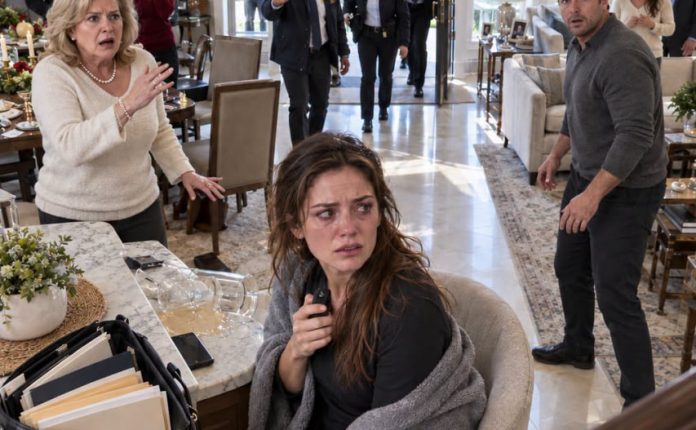
I drove to my parents’ house but remained across the street while two unmarked cars sat in the driveway. Through the dining-room window, I saw Dad speaking with investigators. Mom stood near the staircase, twisting a tissue between her hands.
Lila’s car arrived minutes later.
She rushed toward my vehicle instead of the house.
“What did you give them?” she demanded.
“Bank records and messages.”
“Dad says you accused him of identity theft.”
“He opened credit in our names.”
“He said Denise handled those applications.”
“Denise has his written instructions.”
Lila stopped.
“What instructions?”
I told her about the false vendor accounts and the affidavit Dad wanted backdated. Her anger faded into fear.
“He was going to blame you?”
“Yes.”
“He told me the police were only asking about a misunderstanding.”
“He has been calling theft a misunderstanding for years.”
She looked toward the house. “What happens now?”
“I don’t know.”
An investigator approached and introduced herself as Detective Serena Walsh. She asked me and Lila to come inside separately for interviews.
Dad sat in the living room with an attorney. He did not look at me.
Mom intercepted me near the kitchen.
“You brought the police into our home,” she whispered.
“Dad brought them here through his choices.”
“They took his computers.”
“Good.”
“How can you say that?”
“Because one of those computers contains a document designed to make me responsible.”
Her face collapsed.
“You knew about that too?”
“No.”
“Would you have believed him?”
She could not answer.
Detective Walsh conducted my interview in my childhood bedroom. The walls were now painted beige, but faint marks remained where I once hung brochures from colleges I hoped to attend.
I described the Thanksgiving dinner, Dad’s confession, the unauthorized transfers, and Denise’s records. I gave her the flash drive after confirming I would receive a property receipt.
“Did you ever agree to invest in Bennett Home Furnishings?” she asked.
“No.”
“Did you perform accounting or advisory work?”
“Never.”
“Did you sign company documents?”
“Only a temporary emergency-contact form when Dad had surgery three years ago.”
She noted the date.
One of the fabricated board documents naming me as an adviser had been created during his recovery. Dad may have copied my signature from that form.
“Are you seeking criminal charges?” she asked.
“I want the truth documented. What charges follow is not my decision.”
“That is correct, but your cooperation matters.”
“I’ll cooperate.”
After the interview, I passed the dining room. Dad finally looked at me.
“You’re proud of yourself?” he asked.
His attorney told him not to speak.
“I asked you a question,” Dad continued. “Are you proud that twelve people may lose their jobs?”
I stopped.
“I am proud I refused to sign away another nineteen years of my life.”
“You benefited from this family.”
“I paid more than seventy-eight thousand dollars into it.”
“We raised you.”
“A child does not owe repayment for being raised.”
His attorney stood. “Robert, stop.”
Dad pointed toward me. “She has always hated her sister.”
Lila entered from the hallway.
“No,” she said quietly. “She paid for me.”
Dad turned toward her.
“You don’t understand the pressure I was under.”
“You told me Mara had plenty of money.”
“I was protecting your education.”
“You opened a loan in my name.”
“I made every payment.”
“Until you didn’t.”
Lila’s voice shook, but she did not retreat.
“You told me to send Mara fake notices. You said she needed to feel useful.”
Dad glanced toward Mom, searching for support. Mom looked away.
Something changed in Lila’s expression as she saw him calculating whom to blame next.
“You were going to accuse Mara of managing the company,” she said.
“That document was a contingency plan.”
“A plan to save yourself.”
“I saved this family.”
“No,” I said. “You kept choosing who would pay for your decisions.”
Detective Walsh asked Dad to return to the living room. His attorney guided him away.
Mom sat at the dining table and covered her face.
“What happens to us now?” she whispered.
It was the question she had asked repeatedly, but its meaning had always been the same: What will happen if Mara stops absorbing the damage?
“I hope you tell investigators the truth,” I said.
She looked up. “Will you ever forgive me?”
“I don’t know.”
The honest answer hurt us both.
“Forgiveness cannot begin while you’re still asking me to protect the lie.”
Mom nodded slowly.
For the first time, she did not argue.
The investigation continued for six months. Dad was not arrested that day, but prosecutors eventually charged him with bank fraud, identity theft, falsifying business records, and attempting to obstruct the investigation.
Denise’s files showed that he had used three employees’ identities to secure credit. Two believed they were signing updated payroll forms. The third signature had been copied without permission.
The company entered court-supervised restructuring. It did not collapse immediately as Dad predicted. A regional furniture chain purchased its legitimate assets and retained nine of the twelve employees.
The bank restored $9,600 taken from my savings without authorization. Recovering the money I knowingly transferred was more complicated because I had initiated many payments myself, even though Dad obtained them through deception.
Rachel Kim, an attorney recommended by Denise, helped me file a civil claim. Dad’s proposed repayment agreement became valuable evidence because it acknowledged that he owed me money.
The family home was sold. After the mortgage and tax liens were paid, little remained. Mom moved into a modest apartment near Aunt Carol.
She began working part-time at a library and attending counseling. For the first several weeks, she called daily, alternating between apologies and subtle requests that I soften my statement.
I ended every call the moment she asked me to protect Dad.
Eventually, she stopped asking.
One afternoon, she invited me for coffee and placed Grandma’s jewelry box on the table.
“I found this before the house was sold,” she said. “It belongs to you.”
Inside were sewing needles, old buttons, and the silver thimble Grandma used with the machine I had sold.
“I told you she would have been proud of your sacrifice,” Mom said. “The truth is, she would have been furious with us.”
Tears filled her eyes.
“I watched you give away everything because it made my life easier. I called you strong so I wouldn’t have to admit I was failing you.”
It was the first apology that named what she had done without excuses.
I accepted the jewelry box.
“I’m not ready for things to be normal,” I said.
“They shouldn’t be.”
We began meeting once a month. Rebuilding trust was slow, uneven, and conditional on honesty. Some months ended in warmth. Others ended with both of us needing distance.
Lila faced her own consequences. The university allowed her to establish an emergency payment plan, but she had to take a campus job and move into shared housing. She sold the designer coat, canceled the expensive interview hotel, and traveled by overnight bus.
She attended the interview wearing a borrowed suit.
She was not accepted into that graduate program.
At first, she blamed Thanksgiving, the investigation, and me. A month later, the school informed her that the decision was based on her limited work experience and an application essay that exaggerated responsibilities she had never held.
She called me after receiving the letter.
“I thought being successful meant looking as if nothing was difficult,” she said. “Dad taught me that appearances were more important than how things were paid for.”
“You still made choices.”
“I know.”
She took a full-time position at a community health organization after graduation and enrolled in one evening graduate course with tuition assistance from her employer.
She began repaying me $150 a month.
I had not demanded it. Her first transfer arrived with a message:
This cannot return your lost time. I want to start by acknowledging what your time cost.
I accepted the payments but told her money alone would not repair us.
“I understand,” she replied.
For once, she did.
Dad initially denied everything. Then investigators recovered emails proving he had directed Denise to alter records and planned to frame me as an unauthorized financial adviser.
Faced with overwhelming evidence, he accepted a plea agreement. He avoided the longest possible sentence but was ordered to pay restitution, surrender business assets, and serve a period of confinement followed by supervised release.
Before sentencing, he requested a private meeting with me.
I agreed only because Rachel attended.
Dad entered wearing a plain suit that hung loosely from his shoulders. Without his office, house, and authority, he looked smaller than I remembered.
“I loved both my daughters,” he began.
“That isn’t an apology.”
He looked down.
“I believed Lila’s education would rescue the family.”
“And what did you believe about me?”
“That you could survive anything.”
“That made it acceptable to use me?”
“No.”
His voice cracked.
“I told myself I would repay you after the company recovered. Every lie required another one. When you kept helping, I treated your trust like a resource.”
The honesty surprised me.
“Why did you make that toast?” I asked.
He closed his eyes.
“I was angry that Lila’s future looked uncertain. I had received another notice from the bank that morning. Praising her allowed me to pretend the sacrifices had achieved something.”
“So you humiliated me.”
“Yes.”
“And when I stopped paying, you tried to blame me.”
“Yes.”
He did not ask forgiveness. Perhaps his attorney had warned him, or perhaps he finally understood he had no right to request it.
“I hope someday you remember something about me besides the worst thing I did,” he said.
“It wasn’t one thing.”
He nodded.
That was the last time I saw him before sentencing.
A year after the Thanksgiving dinner, I sat at a small table in my own apartment with Mom, Aunt Carol, Ben, and Lila. We did not use Grandma’s crystal glasses. I bought ordinary ones from a discount store because I no longer wanted tradition to make dishonesty look beautiful.
Before dinner, Lila stood.
“I want to make a toast,” she said.
My stomach tightened.
She lifted her glass toward me.
“To Mara, who should never have been required to prove her worth through sacrifice. I’m grateful for what she gave me, ashamed of how I treated her, and proud that she finally chose herself.”
Nobody laughed.
Mom wiped her eyes. Aunt Carol squeezed my hand.
I raised my glass, but I did not tell Lila everything was forgiven. Healing was not a performance, and I would never again offer promises simply because a family moment seemed to require them.
“Thank you,” I said.
That was enough.
The following January, I enrolled in two evening classes at the community college. I chose business administration, not because Dad’s company had defined me, but because years of tracking bills, negotiating deadlines, and uncovering financial deception had taught me I was capable of more than anyone acknowledged.
I reduced my hotel hours and kept my insurance position. The restored money covered tuition without another job. For the first time, I bought textbooks for myself.
On the morning of my first class, Lila sent me a photograph of the $150 transfer she had scheduled.
Beneath it, she wrote:
Your education matters too.
I sat in my car outside the college and cried—not because the message repaired everything, but because my future was finally receiving some of the care I had poured into everyone else.
Dad’s Thanksgiving toast had been intended to define me as the daughter who failed to become something.
Instead, it ended the arrangement that kept me from becoming anything for myself.
I had spent years confusing love with endless rescue. I now understood that generosity without boundaries could become permission for others to erase me. Saying no did not destroy my family. It exposed the damage we could no longer pretend was normal.
I entered the classroom, chose a seat near the front, and opened a brand-new notebook.
For once, every hour I worked and every dollar I spent belonged to the life I was building.
And that life was finally mine.
THE END
Disclaimer: Our stories are inspired by real-life events but are carefully rewritten for entertainment. Any resemblance to actual people or situations is purely coincidental.